

This article steps slightly away from our usual topic of importing from China, but since the story comes directly from China—and it’s highly relevant right now—we believe you’ll find it both interesting and useful.
Over the past two years, rising lithium prices and supply shortages have opened the door for sodium-ion batteries as a viable alternative. As a result, they’ve quickly gained attention across the industry.
In fact, many in the industry called 2023 the “year of sodium-ion batteries.” Companies developing this technology received strong financial backing, while major lithium battery manufacturers and car makers also began investing heavily in sodium-based solutions.
How Sodium-Ion Batteries Are Entering the Market
In February 2023, Zhongke Hainan and Sihao New Energy introduced the first prototype vehicle powered by a sodium-ion battery.
Just a month later, Yadea showcased an electric bike using the same technology.
In April, CATL announced that its first sodium-ion batteries would be used in a Chery vehicle.
By the end of the year, sodium-ion batteries had officially entered mass-produced vehicles.
In less than a year, the technology moved from testing to real-world production—an impressive pace by any standard.
On December 27 and 28, 2023, two sodium-ion electric vehicle models were officially unveiled.
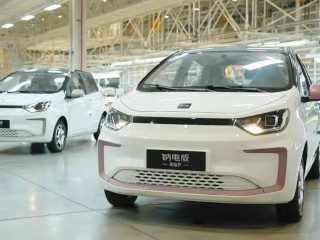
The first sodium-powered EV rolled off the production line in China on December 27. It was developed by Yiwei (a JAC brand) and uses batteries from Hina Battery. The vehicle offers a range of around 252 km and began deliveries in January 2024. Hina has also already deployed these batteries in electric bikes and energy storage systems.
Just one day later, Funeng Technology and Jiangling Group introduced their own compact EV with a sodium-ion battery. This was their first mass-produced model, with deliveries also starting in early 2024.
The vehicle offers a range of up to 251 km, placing it firmly in the category of small urban electric cars.
According to Chinese media, the spike in lithium prices during 2022 pushed major players like CATL and EVE Energy to accelerate sodium-ion development. Meanwhile, companies like BYD are actively testing their own sodium-based battery solutions.
What Are Sodium-Ion Batteries?
Sodium and lithium belong to the same group of chemical elements, which means they behave similarly in battery applications.
Interestingly, both lithium-ion and sodium-ion battery technologies were first researched back in the late 1970s. However, technical limitations at the time meant sodium-ion batteries stayed in the lab—until recently.
Things changed around 2021, when lithium prices surged dramatically. Suddenly, sodium-ion batteries—after decades of waiting—became a serious alternative.
One key advantage is resource availability. Sodium is abundant worldwide, unlike lithium, which is relatively scarce and unevenly distributed. China alone holds around 22% of global sodium resources.
Lithium, on the other hand, makes up just 0.0065% of the Earth’s crust, with over 70% concentrated in Chile, Australia, and Argentina. China holds only about 7%, often in hard-to-access regions like Tibet.
This imbalance is one of the main reasons China is strategically investing in sodium-ion battery development—to reduce dependence on imported raw materials.
Today, over 100 companies are involved in the sodium battery supply chain. Production capacity is expected to grow rapidly, reaching 60 GWh by 2025.
Another advantage is that sodium-ion batteries can be produced using existing lithium-ion manufacturing equipment. This allows factories to switch production lines relatively quickly.
Performance Comparison
When it comes to safety and temperature performance, sodium-ion batteries have a clear edge.
They can operate in extreme conditions—from -40°C to 80°C—and retain about 90% of their capacity even at -20°C. This is significantly better than most lithium batteries.
They are also inherently safer. Due to lower heat generation and higher thermal stability, they are less prone to fires or explosions.
However, there is a major downside: lower energy density.
Simply put, sodium batteries store less energy for the same weight. Currently, they offer roughly half the energy density of lithium-ion batteries, which translates to shorter driving range.
For example, a lithium-powered EV with a 31 kWh battery might deliver a range of 301 km. A sodium version of the same vehicle would offer around 251 km with a smaller 21.4 kWh battery.
The price difference? Around $500 cheaper. The question is—does that justify the reduced range?
For now, sodium-ion batteries are mainly used in small city vehicles designed for short distances.
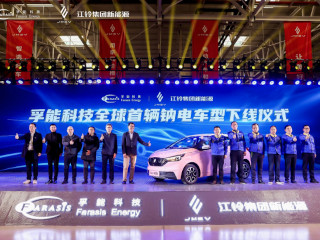
Two early models—the HuaXianZi and Jiangling Yizhi EV3—both offer ranges of around 250 km, confirming their focus on urban mobility.
Industry experts believe sodium-ion batteries will first dominate smaller vehicle segments, as well as replace lead-acid batteries in scooters and three-wheelers.
They also show strong potential in energy storage systems.
Current sodium batteries offer energy densities between 140–160 Wh/kg, with next-generation versions expected to reach up to 200 Wh/kg by 2026.
They’ve already passed key safety tests, including overcharging, compression, and water exposure, while maintaining stable performance.
Combined with lower costs and abundant raw materials, sodium-ion batteries are becoming an increasingly attractive option.
Falling Lithium Prices Change the Game
However, the story doesn’t end there.
In 2023, lithium prices dropped by more than 80%, causing lithium battery costs to fall sharply as well.
This raises an important question: will sodium-ion batteries lose momentum?
When lithium was expensive, sodium looked like the perfect alternative. Now that prices have dropped, its advantage is less obvious.
According to market data, lithium carbonate prices fell from around 500,000 yuan per ton to just over 100,000 yuan within a year.
This shift is already slowing investment interest in sodium-ion technology.
What This Means for Battery Prices
As distributors of Bluesun solar systems, we’re already seeing signals that battery prices are likely to decrease soon—even if solar panel prices remain relatively stable.
One thing is clear: China is building a fully integrated energy ecosystem—combining renewable energy production, ultra-high-voltage transmission, and large-scale energy storage.
Sodium-ion batteries are expected to play a key role in that system.
And from a cost perspective, there’s real potential. Batteries account for roughly 40% of an electric vehicle’s price, and sodium—being widely available—could help bring costs down over time.
Whether that translates into significantly cheaper EVs remains to be seen—but it’s definitely a trend worth watching.
Sources: 36kr, YesAuto, CleanTechnica.