

A proof of origin document confirms where a product really comes from and is used when a trade agreement allows preferential (reduced or zero) duty treatment. In practice, this document can save you a lot of money on imports and exports — but only if the goods actually meet the rules of origin.
In other words, it’s not enough that the shipment simply leaves from a certain country — what matters is where the product was truly produced or sufficiently processed. That’s why rules of origin are one of the most important parts of any free trade agreement.
Certificate of origin: what it is, what it does, and how it’s used
A certificate of origin (or other proof of origin) is a document that confirms a product qualifies as originating in a specific country. Based on this document, customs can apply a lower or even zero duty rate if a trade agreement allows it.
This document is especially important in international trade because it prevents abuse and ensures that only products which genuinely meet the origin criteria can benefit from preferential tariffs.
Depending on the agreement and type of goods, the proof of origin can have different names, formats, and issuance procedures. In some cases, it’s issued by an authorized body; in others, the exporter provides a statement on the invoice or another form of self‑declaration.
Why origin matters
Origin matters because it determines whether a product can access preferential duty treatment. If the goods don’t qualify as originating, customs charges the regular duty rate with no discounts.
The difference between “normal” goods and goods with qualifying origin can be huge in terms of total landed cost. That’s why origin and documentation are usually checked well before shipment — not only when the goods arrive at the border.
How origin is determined
Goods can obtain origin in several ways, depending on the rules in the relevant trade agreement:
- Wholly obtained or produced goods – the product is entirely obtained in one country, for example certain agricultural products, minerals, or other natural products.
- Sufficiently worked or processed goods – the product is made from non‑originating materials, but the processing in the country of manufacture is substantial enough for the final product to obtain originating status.
- Cumulation of origin – materials from one FTA partner country can be treated as originating when used in another partner country to produce the final product, if the agreement allows it.
For example, if your product is manufactured in China but some components come from third countries, you must check whether the finished product still meets the origin rules in the agreement you want to use.
On top of these basic concepts, many agreements include product‑specific rules and extra conditions such as direct transport, territoriality, and record‑keeping requirements for origin verification.
What the document looks like in practice
The image below shows a stamped certificate of origin confirming that the goods are of Chinese origin. Sensitive data on the document has been blurred.
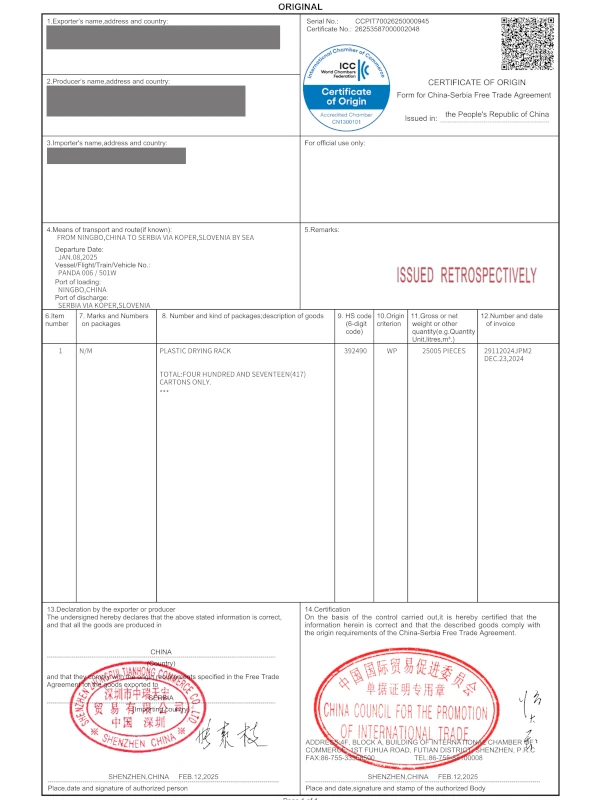
This kind of document is the key proof customs uses to grant preferential treatment. If the document is incorrect or incomplete, customs may deny the preference and charge the full regular duty rate.
Who issues the certificate of origin?
Depending on the agreement, a certificate of origin can be issued by an authorized body in the exporting country (for example a chamber of commerce or customs authority) or it can be provided as an exporter’s declaration on the invoice or a separate form.
In many cases the document is issued before shipment, but some agreements allow it to be issued retroactively, as long as the specific conditions for late issuance are met.
What customs actually checks
Customs doesn’t just look at the paper itself — they check whether the document matches the real goods. They will verify data consistency, the origin of materials, how the product was manufactured, and whether the shipment complies with the agreement’s transport and territoriality rules.
If there are discrepancies in the paperwork or doubts about whether the goods truly meet the origin criteria, customs can request additional evidence or refuse to grant preferential treatment.
Common mistakes in practice
One of the most common mistakes is confusing the country of dispatch with the country of origin. Goods may be shipped from one country but not actually have origin there.
Another frequent issue is incomplete or inconsistent documentation. If the details on the invoice, packing list, and certificate of origin don’t match, customs may trigger extra checks or hold the shipment.
A third mistake is assuming that every product automatically qualifies for preferential duty just because a trade agreement exists. In reality, each product has to meet precise rules of origin for that specific agreement.
Conclusion
The certificate of origin (or other proof of origin) is a key piece of the paperwork in international trade because it unlocks preferential duty rates when all conditions of the trade agreement are met. Without valid proof of origin, your shipment is treated under standard duty rules.
Before shipping, always double‑check the origin rules, documentation, and agreement conditions to avoid extra costs, delays, or issues at customs. It’s one of the simplest ways to make your import and export operations safer and more profitable.
Frequently asked questions about certificates of origin
1. What is a certificate of origin?
A certificate of origin is an official document that confirms a product qualifies as originating in a particular country under the rules of a specific trade agreement. Customs uses it to apply reduced or zero duty where the agreement allows.
2. Is it enough that the goods are shipped from a country to claim origin there?
No. Origin is not based on the country of shipment, but on where the goods were actually produced or sufficiently processed. A product can be shipped from one country and still not have origin in that country.
3. Who issues the certificate of origin?
Depending on the agreement, a certificate of origin may be issued by an authorized body in the exporting country (such as customs or a chamber of commerce), or it may be drawn up by the exporter as a specific statement on the invoice or a separate form.
4. What does customs look at when checking a certificate of origin?
Customs checks whether the document reflects the real situation: consistency of data with the invoice and packing list, how the goods were produced, origin of materials, transport conditions, and whether the origin rules in the agreement are met.
5. What are the most common mistakes with certificates of origin?
The most common mistakes include mixing up the country of dispatch and the country of origin, inconsistent data between the invoice, packing list and certificate, and assuming every product automatically qualifies for preferential duty without checking the specific rules of origin.
Customs Guide
Customs clearance and documentation for imports from China
In this guide, we walk you through the customs process step by step – from the essential paperwork to a real-world duty and VAT calculation.
Customs clearance basics
A simple explanation of duties and the CIF value, an overview of import duty levels for Chinese products, and useful links to customs tariff databases by country.
HS codes for imports from China – practical guide
What HS codes are, how to find the correct code for your product, how they affect duty rates, and why misclassification can lead to delays and extra costs.
Finding Suppliers in China
Go back to our guides on how to choose and verify suppliers in China.
← Back to SuppliersQuality Control
Once you've chosen your product and supplier, it's smart to arrange a quality inspection before placing your order.
Continue to Quality Control →Back to: ← Customs & Documentation Guides
Back to: ← China Sourcing Hub