

HS codes (Harmonized System codes) are a global standard for classifying products in international trade, used by more than 200 countries around the world.
Every product you import or export is assigned a numeric code that describes what it is and how it’s used. These codes are crucial for setting customs duties and taxes, applying bans and restrictions, and compiling international trade statistics.
When importing from China, the correct HS code is especially important, because it directly affects your duty rate, whether you can use a free trade agreement, and your total landed cost.
In this guide, we’ll explain how HS codes work, how to find the right one for your product, and how to “translate” it into the exact customs tariff code used in your country.
The HS system is the backbone of modern trade compliance and a core part of the global customs framework – so in the rest of this article we’ll break it down in a practical, beginner‑friendly way.
1. What is an HS code?
An HS code is a numeric product identifier used by more than 200 countries in customs declarations. It was developed by the World Customs Organization (WCO) and provides a standardized way to classify over 5,000 product groups. HS codes are the foundation of most national customs tariff systems and directly influence tariff schedules in trade agreements.
2. Short history and development
The HS system was introduced in 1988 and has since become the basis for virtually all national tariff nomenclatures. It’s updated every five years to reflect new technologies, new products, and changes in global trade, which keeps it relevant for both import and export classifications.
3. How HS codes are structured
Every HS code has 6 core digits, broken down like this:
- First 2 digits – chapter
- Next 2 digits – heading
- Last 2 digits – subheading
Individual countries then extend this base to 8 or more digits (for example, CN codes in the EU, TARIC codes in the EU and Serbia, or HTS codes in the US) to classify products in more detail.
4. Why HS codes matter
- Without the right HS code, you can’t accurately calculate your customs charges with any duty calculator.
- Your shipment can be held or sent back at the border.
- You risk breaking international trade regulations.
- You lose time and money fixing issues that were avoidable.
5. How to find the right HS code
- Use online databases such as the TARIC system (for the EU).
- Ask your freight forwarder or customs broker to help you classify the product.
- Check the official customs tariff classification published by your country (more on this in our article Customs Rates and Tariffs by Country).
- Use tools such as the WCO HS explanatory notes or online tariff search apps.
6. Common classification mistakes
- Using a code from another country without checking your local tariff first.
- Picking a code based on how a product looks instead of what it does.
- Using outdated codes that were removed in the latest HS revisions.
7. Examples of HS codes
The examples below are for illustration only – always check the actual subheadings and duty rates in your country’s official tariff.
- Car tires – 4011.10
- Laptop computers – 8471.30
- Plastic bottles – 3923.30
- Cotton T‑shirts – 6109.10
8. HS codes in Serbia
Serbia uses a combined nomenclature aligned with the European CN codes. The Serbian Customs Administration publishes updated tariff schedules with local extensions, while the TARIC system provides extra details on trade policy measures.
For more on customs duties for imports from China into Serbia and the Serbia–China free trade agreement, see: How Serbia–China Free Trade Agreement Duty Groups Work.
9. The TARIC system
TARIC (the Integrated Tariff of the European Union) is a comprehensive EU database that includes all applicable customs duties, control measures, bans, quotas, and other trade measures for each tariff line. It’s a key tool for anyone doing tariff classification within the EU.
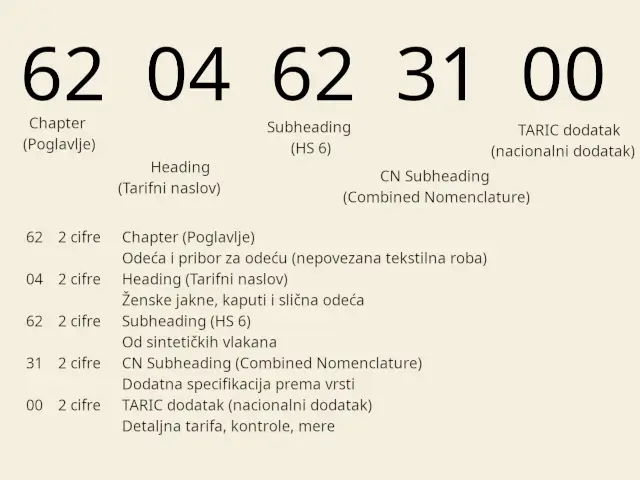
What you see in the screenshot
The first 6 digits (620462) are part of the international HS system used by all WCO members.
The next 2 digits (31) belong to the EU Combined Nomenclature (CN) – they further refine the HS code and are used across all EU member states.
The last 2 digits (00) are an additional extension within the EU (CN/TARIC), used to link extra measures such as anti‑dumping duties, quotas, or other trade restrictions.
10. HS codes in the US
In the United States, the system is called HTSUS (Harmonized Tariff Schedule of the United States). It’s based on HS codes and extends them to 10 digits. The schedule is published and updated by the USITC, and US Customs and Border Protection (CBP) uses it to apply duties, quotas, and trade agreements.
11. HS codes in China
China uses its own tariff system built on HS codes, extended through the China Customs Tariff. The system includes extra markers for inspection, permits, and export controls. The responsible authority is the GACC (General Administration of Customs of China), and duty rates can vary depending on trade agreements or free trade zones.
Similarities between the EU, US, Serbia, and China
| Element | EU | US | Serbia | China |
|---|---|---|---|---|
| Base system | HS (Harmonized System) | HS | HS | HS |
| First 6 digits | Yes (same globally) | Yes | Yes | Yes |
| Hierarchical structure | Yes | Yes | Yes | Yes |
| System goals | Classification, duties, controls | Same | Same | Same |
| Updated per WCO | Yes, every 5 years | Yes | Yes | Yes |
Differences between tariff systems
| Feature | EU (TARIC) | US (HTSUS) | Serbia | China (PRC Tariff) |
|---|---|---|---|---|
| Full code length | 10 digits + extra TARIC codes | 10 digits | 10 digits | 10 digits |
| Additional markers | CN code + extra TARIC codes (e.g. anti‑dumping) | Preference programs (GSP, FTAs), extra legal notes | No separate TARIC layer like the EU, but uses national notes | Extra regulatory and control codes |
| Alignment with EU | – | No | High | Partial (own system built on HS) |
| Regulatory bodies | DG TAXUD (EU Commission) | USITC and CBP | Serbian Customs Administration | GACC (China Customs) |
| Online search | TARIC | HTS Search | Serbia customs tariff | China FTA portal |
12. Using HS codes in documentation
- Customs declarations
- Commercial invoices
- Packing lists
- Certificates of origin
13. How to avoid wrong classification
- Talk to experts and freight forwarders.
- Use official databases and tools for tariff code search.
- Keep an eye on WCO updates, which are published every five years.
Real‑world example: how the wrong HS code can cost you thousands
Importers often underestimate how important correct classification is. One Serbian company ordered LED lighting from China and listed an HS code for electrical components (8536) instead of the specific code for LED lamps (9405). When the shipment arrived, customs requested a re‑check and proper classification. The result: the shipment was held for 12 days, extra duties of 12% of the goods’ value were charged, and the company had to hire an external broker to fix the paperwork.
Mistakes like this are common – and always expensive. That’s why getting the HS code right is critical.
HS, CN, TARIC and HTS: what’s the difference?
| Abbreviation | Meaning | Where it’s used | Length |
|---|---|---|---|
| HS | Harmonized System | Global (WCO standard) | 6 digits |
| CN | Combined Nomenclature | EU + Serbia | 8 digits |
| TARIC | Integrated Tariff | EU (detailed measures, anti‑dumping) | 10 digits |
| HTS | Harmonized Tariff Schedule | US | 10 digits |
Important: the 6‑digit HS code is only the shared base. For real customs clearance, you always need the extended national code (CN/TARIC in the EU and Serbia, HTS in the US, China’s national tariff, etc.), because that’s where the exact duty rates, anti‑dumping measures, quotas, and other import conditions are defined.
Where to check duties by HS code
The HS code directly affects your duty rate, but the customs declaration uses your country’s extended tariff code (CN/TARIC, HTS, national tariff), which is built on top of the HS system.
- Customs duty rate (percentage applied to the base value)
- Any additional charges (for example excise, anti‑dumping)
- VAT calculation
- Licences, inspections, or other requirements
Example of a rough duty calculation
Invoice value: 10,000 EUR
HS code: 850440 (chargers and adapters)
Duty rate: around 2–5% (depending on country and agreements)
Customs duty (say 3%): 300 EUR
VAT (20% on value + duty): 2,060 EUR
Total duties and taxes: 2,360 EUR
Note: Exact rates vary and must be checked in official databases. Free trade agreements can also reduce or eliminate duties for eligible products.
Where to check the rates
How to find the correct HS code in China
- HSCode.net – Chinese portal
- GACC – China Customs
- Alibaba seller info – only as a rough starting point
Important: A code from China often won’t match the exact TARIC/HTS code used in your country. Always double‑check in the importing country’s tariff.
Risks of wrong classification
- Delays and shipment holds
- Fines and penalties for incorrect data
- Back‑dated duties after an audit
- Losing preferential duty rates under free trade agreements
Where do you need to list the HS code?
- On pro forma and commercial invoices
- On packing lists (where relevant)
- In the customs declaration
- On certificates of origin
Serbia has customs benefits in trade with China
thanks to the Serbia–China free trade agreement, which entered into force on 01.07.2024.
Here’s how it works in practice:
-
How Serbia–China Free Trade Agreement Duty Groups Work includes:
- Gradual removal of customs duties on a large number of products from China.
-
Preferential duty rates (often 0%) for certain products – but only if all conditions are met:
- The goods are of Chinese origin (proved by a Certificate of Origin).
- The HS code is classified correctly.
- The importer explicitly claims preferential treatment in the customs declaration.
However, if:
- You don’t have a Certificate of Origin (Form E),
- Or you don’t tick the box for preferential treatment in the declaration,
then the full duty rate from TARIC or the Serbian customs tariff will be applied.
14. The future of HS codes
Digitalization and AI in logistics and trade are creating both challenges and opportunities for automatic product classification. Future HS revisions will focus more on new technologies, e‑commerce, and environmental protection, making the product classification system more dynamic.
What’s likely coming next
- AI‑powered automatic classification
- Blockchain‑based traceability of goods
- Deeper integration with e‑commerce platforms (Temu, Shein, AliExpress)
Conclusion
An HS code is more than just a number – it’s the foundation of compliant, efficient international trade. Accurate classification saves money, reduces risk, and keeps your imports running smoothly. Don’t leave your HS code to guesswork: talk to experts and use official tools and databases, and keep up to date with changes in the Harmonized System.
Frequently asked questions about HS codes
Is it enough to know only the 6‑digit HS code?
Not really. The six HS digits are just the international base – for actual customs clearance you always need the extended national tariff code (CN/TARIC, HTS, or your local tariff), which uses the HS structure to define the exact duty rates, measures, quotas, and restrictions.
Can I just use the HS code my Chinese supplier gave me?
The supplier’s code is a good starting point, but it’s not a guarantee that it’s correct for your country. Always verify the code in your local customs tariff or with a freight forwarder, because local extensions (CN, TARIC, HTS) and duty rates can differ.
What happens if I declare the wrong HS code?
Incorrect classification can lead to shipment holds, extra duties, fines, or back‑dated payments after an audit. In more serious cases, you can lose preferential duty rates or even face seizure of goods.
Who can help me find the correct HS code for my product?
You can get help from freight forwarders, customs brokers, or directly from the customs authority. For complex products, it’s often best to request an official ruling or advance binding tariff information.
Does the HS code affect whether I can use the Serbia–China free trade agreement?
Yes. Preferential duty rates apply only to products that are correctly classified, have valid proof of origin, and for which preferential treatment is clearly claimed in the customs declaration. A wrong HS code can mean losing access to reduced or zero duties, as explained in the section on customs benefits under the Serbia–China agreement.
How can I check if my product qualifies for preferential rates under the Serbia–China agreement?
You need to: 1) find the correct HS code for your product; 2) check Serbia’s customs tariff or the official duty tables for imports from China to see which group it belongs to (A0, A5, A10, A15, or E); 3) see whether the duty is already 0% or being reduced over time; and 4) get a Certificate of Origin (Form E) from your Chinese supplier and declare that you’re using the preferential regime in your customs declaration.
Customs Guide
Customs clearance and documentation for imports from China
In this guide, we walk you through the customs process step by step – from the essential paperwork to a real-world duty and VAT calculation.
Customs clearance basics
A simple explanation of duties and the CIF value, an overview of import duty levels for Chinese products, and useful links to customs tariff databases by country.
HS codes for imports from China – practical guide
What HS codes are, how to find the correct code for your product, how they affect duty rates, and why misclassification can lead to delays and extra costs.
Finding Suppliers in China
Go back to our guides on how to choose and verify suppliers in China.
← Back to SuppliersQuality Control
Once you've chosen your product and supplier, it's smart to arrange a quality inspection before placing your order.
Continue to Quality Control →Back to: ← Customs & Documentation Guides
Back to: ← China Sourcing Hub