

In recent years, the United States has repeatedly imposed high tariffs on goods from China, including solar panels, vehicles, steel, aluminum, and other products. Some of these measures began under Donald Trump’s administration, and were later maintained or adjusted by President Joe Biden’s administration.
In practice, tariffs are an additional cost on imported goods, formally paid by importers in the US, but often passed on to end customers through higher prices.
The Biden administration has kept most of the existing tariffs on Chinese goods and in some areas has even tightened them further—especially for solar panels, batteries, computer chips, steel, and aluminum. Tariffs on Chinese electric vehicles have also drawn particular attention, with officials arguing that the aim is to protect domestic industry and US jobs.
“I’m determined that the future of electric vehicles will be made in America by union workers. Period!”, President Biden said when explaining part of these measures.
Contents
EU Tariffs on Chinese Electric Vehicles
The European Union has also tightened its trade measures toward China. New tariffs on Chinese electric vehicles range roughly between 17.4% and 37.6%, on top of the existing 10% base duty on passenger cars.
According to the European Commission, the additional tariffs take effect on 5 July, following an investigation that found state subsidies along the entire supply chain—from battery raw materials to logistics and exports of finished vehicles.
The tariffs are differentiated by manufacturer, depending on the assessed level of subsidies and the degree of cooperation during the investigation:
- BYD: around 17.4%
- Geely: around 19.9%
- SAIC: around 37.6%
Other Chinese EV manufacturers that cooperated with the investigation face a rate of around 20.8%, while non-cooperating producers are subject to the highest rate of around 37.6%.
The measures were initially introduced as provisional, with a final EU‑level decision to follow later. While Italy and France supported the tariffs, Germany was more cautious because of its carmakers’ strong ties to the Chinese market.
Why Brussels Is Imposing Tariffs
One of the main drivers was the rapid increase in the presence of Chinese electric vehicles on the EU market. While fewer than 20,000 China‑made vehicles were sold in the EU in 2017, by 2023 that number had risen to several hundred thousand per year.
Chinese industrial and climate policies are further reinforcing this trend. Under previous plans, China aimed to sharply limit sales of vehicles with internal combustion engines over the coming decades, with some provinces going even further and targeting an earlier shift to electric vehicles.
This means part of the conventional vehicle fleet will be looking for new markets, and some of it is already ending up in Central Asia and Africa. This raises questions about how the global used‑car market will adapt to these changes.
Low-Value Parcels from China
Another important area of trade tension concerns low‑value parcels from outside the EU. Under current rules, online purchases shipped from non‑EU countries are exempt from customs duties if their declared value is below 150 euros.
This has opened the door to a massive flow of small e‑commerce parcels from China via platforms such as Temu, AliExpress, and Shein. EU authorities have argued that a significant share of these goods is borderline or below EU standards, while at the same time avoiding more detailed controls.
Estimates suggest that more than two billion items with a declared value below the 150‑euro threshold were imported into the EU over the previous year.
The European Commission has been considering scrapping this threshold, which would subject even low‑value goods from third countries to customs procedures. The main targets mentioned are large platforms that ship huge volumes of small parcels directly to end customers.
Container Shipping from China
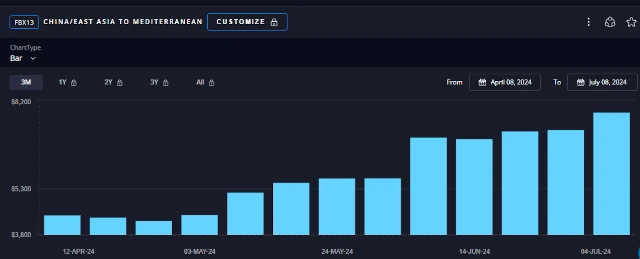
As if new tariffs were not enough, global trade is also facing rising transport costs. Container shipping rates are climbing again and on some routes are approaching levels last seen during the pandemic.
The cost of shipping a 40‑foot container from China to Mediterranean ports has at times reached several thousand dollars, while transport in the opposite direction is significantly cheaper. These gaps have a direct impact on importers’ and exporters’ cost calculations.
Exports from Serbia to China
For companies in Serbia, one piece of good news is the entry into force of the free trade agreement between Serbia and China, which removes or reduces tariffs on a wide range of products. The agreement took effect on 1 July 2024 and significantly changes market access conditions in both directions.
Serbian exporters looking to sell into China also benefit from relatively favorable transport costs to Chinese ports compared with the cost of importing from China into Europe.
However, having a good product is not enough. Entering the Chinese market takes time, investment, and consistent work on building brand recognition and customer trust.
Our experience shows that building a stable network of regular buyers is neither quick nor easy. Participating in relevant trade fairs, along with investment in local marketing, distribution, and promotion, is practically essential.
If you do manage to establish a position on the Chinese market, the result can be long‑term and substantial. For many companies, it can become the most important strategic move they make.
If you are considering exporting to China and need support with product selection, partner search, or organizing import and export, we are here to help.
Frequently Asked Questions (FAQ)
Do tariffs really make goods more expensive?
Yes. Although tariffs are formally paid by importers, the cost is often passed on to end customers through higher retail prices.
Why is the EU imposing tariffs on Chinese electric vehicles?
The main goal is to protect the European automotive industry and offset the advantages Chinese manufacturers gain from state subsidies.
What does the 150‑euro threshold for small parcels mean?
Under current rules, shipments from outside the EU with a declared value below 150 euros are exempt from customs duties, which has enabled a strong increase in small e‑commerce parcels.
How do tariffs affect shipping from China?
Beyond the tariffs themselves, global trade is also affected by higher container freight rates, which further push up import costs.
Does Serbia have an advantage when exporting to China?
Yes, the free trade agreement between Serbia and China makes it easier to export certain products and can be a significant advantage for Serbian exporters.
← Back to: Doing Business with China