

Note (update): This article looks at transport prices in 2020, at the height of the COVID‑19 pandemic. Rates and market conditions are very different today, so use this piece as historical context to understand how sudden market shocks affect importers, not as a source for current pricing.
Companies involved in global trade mainly use two types of transport: ocean freight and air freight. Shipping costs matter a lot, because they affect the final product price and directly impact the people who buy imported goods.
- Transport prices are driven directly by supply and demand.
During 2020, a series of unusual events pushed the market away from the normal seasonal patterns that shipping lines, suppliers, and traders were used to.
In this article, we look at how ocean freight and air freight prices changed during 2020. We also review the impact of COVID‑19 and what people expected to happen in 2021.
Ocean freight and price trends
Several factors shaped ocean freight trends in 2020, with COVID‑19 and trade rules between the United States and China having the biggest impact.
At the start of the year, demand for shipping services fell, because traders were cautious about rebuilding inventory while the pandemic was spreading and uncertainty was rising around the world. Shipping lines cut capacity globally to match weaker demand and try to keep prices as stable as possible.
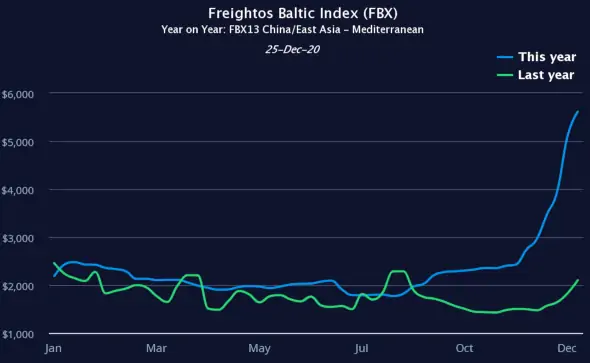
But demand surged sharply later in the year, and carriers kept rates at a much higher level after that. This kind of spike is typical in peak season, but in 2020 it started as early as September.
One of the main reasons was that retailers brought holiday buying forward. They did this to avoid crowding in stores right before and during the holiday period, and also to make social distancing easier and protect customers from COVID‑19.
The peak season for ocean freight usually ends by November, but that year it stayed strong well into December. This longer peak season was the result of higher demand. Some forecasts at the time suggested it could continue until February, but nobody could know that for sure.
Another reason demand increased was that spending moved away from services and toward goods. People could not go to restaurants, bars, cinemas, and other places, or travel the way they used to. Instead, they started spending more on products, especially items for their homes.
Business inventory restocking also boosted demand, as companies quickly rebuilt stock levels after reducing them earlier because of COVID-related uncertainty.
It is also worth noting that transport from Asia to the United States showed some unusual activity even before COVID‑19 became a global issue.
Air freight trends
Air freight demand followed a similar pattern to ocean freight, but air cargo capacity fell sharply in 2020. Around 90% of air freight normally travels in passenger aircraft. When passenger flights dropped quickly and demand for goods rose at the same time, especially for personal protective equipment such as masks, gloves, and suits, air freight prices jumped early in the year.
Rates stabilized by mid-year, but as the season moved on, prices rose again. There were delays, but the system still worked reasonably well overall. Even so, air freight was much more expensive than usual.
How COVID‑19 affected freight transport
COVID‑19 affected freight transport in several ways, both directly and indirectly. Fear of the virus changed how businesses made decisions, and restrictions changed how people spent money.
As we know, freight rates are directly shaped by supply and demand.
Early in the year, COVID caused a short drop in demand, before demand kept rising through the second half. Air cargo capacity shrank because travel restrictions reduced the number of passenger flights. Ocean freight, on the other hand, kept the same fleet — the number of ships was basically unchanged — so supply could not expand quickly enough to match the sudden jump in demand.
Overall, freight rates fell sharply at the beginning of the year before starting a steady climb. Once demand moved higher, supply and demand shifted in a way that pushed shipping costs up.
The impact of digitalization on freight transport
According to the US Census Bureau, the United States saw a big increase in the number of small businesses during 2020. Many people lost their jobs or realized how unstable their jobs were, so they decided to start their own businesses.
Global digitalization and the shift toward e-commerce made it easier for sellers to connect with both customers and suppliers online.
Online trade was not the only reason transport got more expensive, but it definitely added fuel to the fire. B2B marketplaces such as Alibaba.com make it easy for traders to source products from around the world. B2C e-commerce is relatively easy to copy, so many new entrepreneurs tried to launch their own online stores or sell through platforms like Amazon.
It is common for business owners to source products from suppliers in countries with lower production costs, such as China, India, and Vietnam. As more businesses manufacture abroad, demand for freight transport rises.
Who do these changes affect?
When transport costs move around, someone has to absorb them. That can be the supplier, the trader, or the consumer — but the money has to come from somewhere.
Sometimes suppliers or traders choose to cover part of the cost themselves to keep customers loyal. But many small businesses simply cannot afford that.
Businesses have to decide what makes the most sense for them. As consumers, we all worry that sellers will be forced to raise prices when freight rates rise too much.
What was expected for 2021
2020 was an unusual year for freight because of COVID‑19, so 2021 also looked highly unpredictable at the time.
What would happen with transport in 2021 depended on when supply and demand would return to their normal annual cycle. Unfortunately, it was hard to predict what came next, because COVID cases were rising again and many countries were going back into lockdown. The rollout of vaccines gave people hope that seasonal trends would slowly normalize, but it was still too early for reliable forecasts.
On top of that, the inauguration of the new US president could affect freight flows and tariffs between the US and Asia. Some of the policies that had pushed freight rates down at the beginning of 2020 were linked to the so‑called Trump tariffs.
Planning for the next year was extremely difficult, so the best advice was to stay as flexible as possible. Businesses needed a plan A, but also a plan B and plan C — and they had to expect the unexpected. In the ideal scenario, the COVID‑19 vaccine would gradually return us to a more normal life, but nobody could promise that everything would unfold that smoothly.
What this period means for importers today
The 2020 experience showed how quickly transport prices can jump — sometimes by several times — and how sudden supply chain disruptions can affect import costs and final product prices. Freight rates are different today than they were at the height of the pandemic, but they are still sensitive to seasonality, route changes, and global events.
To understand how prices are formed today, which costs are included, and when it makes more sense to use LCL, FCL, or air freight, take a look at our complete guide to shipping from China.
Shipping Guide
Complete guide for shipping goods from China
A detailed overview of the goods journey from factory to your warehouse: shipping stages, realistic delivery times (45–60 days), the role of freight forwarders, cost structure, and the most common mistakes importers make when organizing logistics.
Containers for Shipping from China
Container types (20ft, 40ft, 40ft HC, Open Top, Flat Rack), their dimensions, volume, and capacity, plus tips on how to choose the right container and pack your goods properly.
Incoterms 2020
A guide to Incoterms 2020 from the importer's perspective: the difference between EXW, FOB, CIF, DAP, and DDP, who pays for which part of the journey, when risks transfer, and why we most often recommend FOB or DAP to beginners instead of the "cheapest" options.
Quality control
Go back to our guides on product quality control in China.
← Back to Quality controlBack to: ← Shipping from China
Back to: ← China sourcing – start here