
PVA – polyvinyl alcohol – is a synthetic, water‑soluble thermoplastic polymer. The pioneers of polyvinyl alcohol were German chemists W. Hermann and W. Haehnel back in 1924.
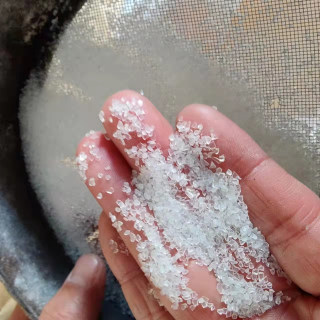
It is a white (less often light yellow or creamy) powder, without smell or taste. It is an artificial solid thermoplastic polymer. It dissolves well in water, as well as in aliphatic glycols, glycerin, aqueous urea solutions, dimethylformamide, and dimethyl sulfoxide. It is resistant to most common organic solvents, oils, gasoline, kerosene, and other hydrocarbons, as well as to diluted acids. It is non‑toxic.
Polyvinyl alcohol is hygroscopic (it absorbs moisture from the air) and always contains around 5% water, which partly plasticizes the material. Water evaporates easily and quickly, so ethylene glycol, butylene glycol, phosphoric acid, and glycerin are used as plasticizers for this polymer. Its density is between 1.19 and 1.31 g/cm³. The melting point is around 200°C, and the decomposition temperature is around 230°C. The chemical formula is (C₂H₄O)ₓ, where x is the degree of polymerization.
Uses of polyvinyl alcohol
Polyvinyl alcohol is an excellent emulsifier, adhesive, and film‑forming polymer. It is characterized by high tensile strength and flexibility. These properties depend on air humidity, because the polymer absorbs moisture, and water acts as a plasticizer. At high humidity, PVA loses strength but becomes more elastic.
Applications
Polyvinyl alcohol (PVA) is used across many industries:
- In the chemical industry, it is used for producing polyvinyl alcohol fibers and polymer films, as a stabilizer in aqueous polymerization of vinyl acetate, and as a binder and thickener in glue and latex production. It also serves as a raw material for other polymers: polyvinyl acetal and polyvinyl nitrate.
- In agriculture, it is used in synthetic fertilizers that improve soil fertility.
- In metallurgy – in steel quenching.
- In the perfume and cosmetics industry – as a component in products for women’s and children’s care.
- In construction, it is used as a protective coating for building materials and as a fiber for concrete reinforcement.
- In the paper, textile, and leather industries, it is used for bonding fabrics, leather, paper, and cardboard, as well as for gluing commercial labels.
- In instrumentation – for producing cyclographic plates and various printed boards.
- In microbiology – for immobilizing enzymes and cells.
- In the conservation of monumental paintings since the 1950s, mainly for preventive lining and as a component of primers in restoration.
- In medicine, it is used as a plasma substitute for blood transfusion, as an embolization agent, as a fixative for sample collection, etc.
- For producing the preparation “Iodinol”, low‑molecular‑weight polyvinyl alcohol carefully purified from impurities is used.
- Special low‑molecular‑weight grades of polyvinyl alcohol are used in the food industry as a food additive (emulsifier E1203).
- It can be found in glazing mixes for seafood and fish, in films and coatings for surface treatment of cheeses and sausages.
- It is used as a thickener and binder in shampoos, adhesives, and latex.
- As a barrier layer for CO₂ in PET bottles (polyethylene terephthalate).
- It is a component in hygiene products for women and children.
- For water‑soluble films in the production of packaging materials.
- For production of polyvinyl butyral.
- In eye‑drop and contact lens solutions as a lubricant.
- As a surfactant in the production of encapsulated nanoparticles.
Safety requirements
Non‑hazardous substance under the Chemicals Act, Dangerous Substances Directive, and EU Recommendations 67/548/EC and 1999/45/EC.
Packaging, transport, and storage
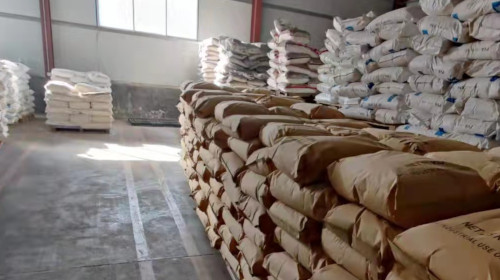
Our polyvinyl alcohol products are packed in paper‑reinforced plastic bags, 25 kg each. In original packaging, polyvinyl alcohol can be stored in closed, dry rooms at room temperature for practically unlimited periods.
Grades and our experience
We offer all standard grades of PVA with the required certificates.
You can read more about our PVA range on the product page: PVA – polyvinyl alcohol
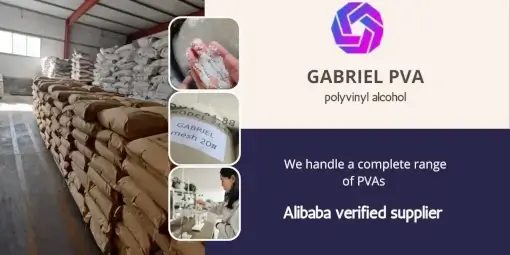
Our PVA (Gabriel Polyvinyl Alcohol) is the product we previously supplied via Alibaba, and we still offer it today with full documentation and technical support for customers worldwide.
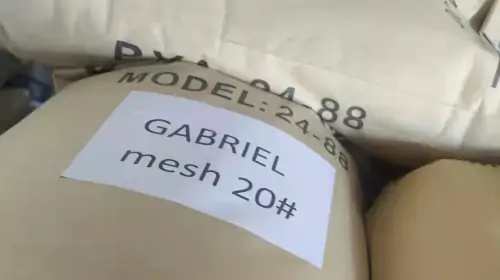
PVA granulation test
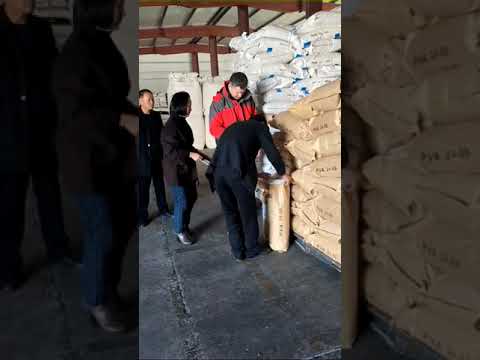
PVA (Polyvinyl Alcohol) granulation and packaging control before delivery to the customer
Frequently asked questions about PVA
Which industries is your PVA (polyvinyl alcohol) suitable for?
Our PVA (Gabriel Polyvinyl Alcohol) is suitable for textile, paper, construction, and chemical industries, as well as for medical, cosmetics, and food applications. You can see detailed grades and technical specifications on the product page.
Does the PVA you offer have the necessary certificates for import into the EU?
Yes. We supply our PVA (Gabriel Polyvinyl Alcohol) with full technical documentation and certificates required for import into the EU and the region (TDS, MSDS, and supporting documents on request).
What are the minimum order quantities for PVA?
Minimum order quantity depends on the PVA grade and shipping method, but in practice, it usually means one or more pallets, or part of / a full container. Let us know your planned quantities so we can suggest the most cost‑effective option.
Do you provide support with import and logistics for PVA?
Yes. In addition to supplying PVA, we can help with organizing transport from China, customs clearance, storage, and quality control, in line with your market and order size.