

Zero-emission technology is moving forward whether we like it or not – especially in China, which aims to become one of the first countries with true zero-emission transport and, over time, a much wider zero-emission economy.
This goal fits perfectly into China’s long-term development plans, so it’s no surprise there are many different manufacturers of electric vehicles and that the number of EVs on Chinese roads is growing quickly.
But for electric vehicles to work on a large scale, you don’t just need cars – you need a whole ecosystem of charging and battery-swapping infrastructure and services.
Back in 2019, Beijing introduced a rule that within two years all newly registered or replaced taxis in the city had to be fully electric.
Based on that decision, we want to show you how China actually implements this in practice: how electric taxis work day-to-day, how they charge, and what public chargers for private EVs look like.
Take a look at a typical charging station. This location has 11 fast chargers and can charge up to 22 vehicles at the same time.
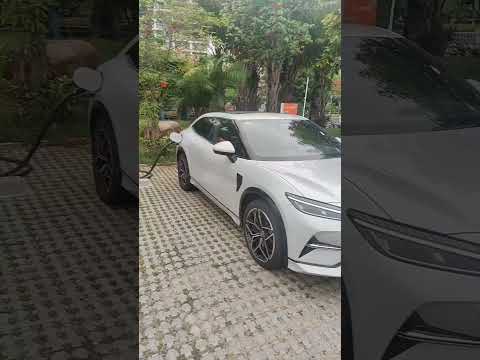
Overview of a typical EV charging station in China
Within roughly a 1 km radius of this spot there are two more similar fast-charging stations for electric cars.
On top of public chargers, almost every residential building has its own EV chargers – sometimes just a few, sometimes entire rows.
Charging prices depend on the time of day, the exact location, and the operator. In our contact Josip’s case, night charging is the cheapest: a full battery for around 7–8 USD gives him roughly 450 km of driving range. Daytime rates are only slightly higher.
How Taxi Fleets Drove EV Adoption
China used taxi fleets as one of the main entry points for mass EV adoption.
City by city, regulations were introduced that required all newly registered or replaced taxis to be fully electric.
Today, we’re at the point where Hainan – the province where Josip lives – is set to become the first province to ban the sale of fossil-fuel vehicles by 2030.
In other words, not just taxis, but all vehicles will need to meet zero-emission standards.
The solution taxi companies rely on most is battery-swapping stations, which reduce dependence on ultra-high-power fast chargers.
Taxi fleets usually operate vehicles from a single manufacturer with its own battery-swapping technology.
This approach allows drivers to replace their car’s battery extremely quickly, at low cost and with high convenience. Here are a few reasons why we believe this technology can play a major role in the future of EVs, especially if battery formats become standardized.
-
Swap speed
A battery swap takes an extremely short time – these stations can complete the process in about one minute, which is ideal for taxis whose income depends on staying on the road.
Compared with fast charging, which can currently take up to 30 minutes to reach around 80% capacity, the advantage of swapping becomes very clear.
-
Drive-through swapping without leaving the car
Stations have an entrance at the front and an exit at the back, so the whole process feels like driving through a car wash.
The car drives onto a platform, the battery is swapped, and then the vehicle drives off – all without the driver needing to step out.
-
Simple payment
As with most services in China, payment is extremely streamlined.
The driver doesn’t even need to take out a phone – license plates are scanned on entry and the fee is automatically charged to the driver’s account.
-
Cost
The service is also very popular because of its price.
A typical swap costs around 55 yuan, roughly 7 euros, for a fully charged battery pack, which usually gives about 400 km of driving range.
-
Smart battery management
The main job of these stations is to swap empty batteries for fully charged ones.
But they also manage the entire battery pool – charging, rotating, and removing faulty packs – with all data stored in the cloud and used to inform users via the app.
-
Smart app support
In the EV world, no service is complete without an app.
The app shows users the distance to nearby stations, the route to get there, how many batteries are available, and estimated waiting times in real time – the closest station is not always the best option.
In the video below, you can see how a battery swap looks on a typical taxi in China.

Battery swap on a taxi
As you can see in the video, the taxi swapped its battery and left with a 100% charged pack in just 93 seconds – faster than filling a completely empty fuel tank at a typical petrol station.
If you run a taxi fleet and you’re thinking about switching to electric vehicles, get in touch with us.
We’ll help you find a suitable battery-swapping and charging station solution in China.
These stations can also be combined with solar panels, which makes the savings even greater.
And that’s not all. China is already using heavy-duty electric trucks with similar fast battery-swap systems.
The principle is a bit different, because battery packs weighing 2–3 tons are removed from above using cranes, but the swap time is still very fast – around five minutes.