

Interested in buying marble and granite from China but not sure where to start?
Looking for reliable stone suppliers at the best possible prices, while still feeling confident about product quality?
Not sure which Chinese stone supplier is actually the right fit for your project?
In this guide, we walk you through, step by step, how to import granite and marble from China, where to find suppliers, and what exactly to pay attention to when sourcing stone products.
Why import marble and granite from China?
1. Great balance of price and quality
China’s granite and marble industry has grown rapidly in recent years and is now highly competitive on the global market.
Thanks to modern machinery, automated processing and large production capacity, Chinese manufacturers can offer quality stone slabs and other stone products at very attractive prices.
When it comes to price, China is hard to beat for most buyers in Europe and the wider region.
As an example from real life, one of our clients told us that famous Brač stone in slab form was cheaper in a Chinese factory than in Croatia. In the end, with our help, they decided to buy the stone directly in China.
2. Large number of producers
China is one of the leading global producers of granite, marble and other natural stone.
Production of marble, granite and related products is mainly concentrated in the provinces of Guangdong, Fujian, Shandong, Hubei and the Guangxi Zhuang autonomous region.
Most major producers operate in these regions, which gives buyers a wide choice of stone types, colors, finishes and price ranges.
3. Opportunity to grow your business
If you’re planning to work with China, importing marble and granite can be a great opportunity for importers, wholesalers and distributors of construction stone.
Demand for these materials is constant, and the offer in China is broad, flexible and usually more affordable than in many other countries.
Where to find granite and marble suppliers in China
Because China has a well-developed stone industry, you can find suppliers in several ways. Here’s where to start:
1. Online
The easiest way to start looking for stone suppliers is online search.
One of the best known platforms is Alibaba, which brings together a large number of traders and manufacturers.
Buying through Alibaba can save you time: you can quickly build a list of potential suppliers, compare offers and later check them in person if you decide to visit China.
2. Trade shows
The Canton Fair is one of the biggest trade shows in China and covers a wide range of industries, including construction materials, equipment and stone products.
In one place you can talk to multiple suppliers, see samples and get concrete offers.
Besides the Canton Fair, there are other specialized stone fairs.
On our website page Trade shows and accommodation you’ll find links to these events under item 5. Building Construction Trade Shows.
If you’d like to see how the search for a stone supplier in China works in practice — with visits to production hubs and on-the-spot negotiations — we recommend reading our guide buying in China on the spot, where we use a real stone sourcing example to show how direct purchasing from manufacturers works.
3. Directly from manufacturers
Leading stone producers are located in areas where raw materials are easy to access.
Direct contact with factories can give you better pricing, more consistent quality and tighter control over the batches you purchase.
Foshan, Guangdong
Foshan is located inland in the Pearl River Delta and is known as one of the main ceramic and stone hubs in southern China. Today there are more than 350 companies focused on ceramic and stone production and development, with over 1,200 production lines. The city is known for product quality, technical development and competitive prices.
Yunfu, Guangdong
Yunfu is a key stone center and the “capital” of artificial stone in China. The city has the largest inland river port in the province, which plays an important role in import and export. Thanks to rich resources, producers from this area offer quality stone, including marble in various colors, onyx, limestone and other stone types at lower prices.
Xiamen, Fujian
Xiamen is a coastal city in Fujian province. This region offers many different stone products, including granite, marble, slate, sandstone and limestone. These materials are used for sculptures, tombstones, slabs, countertops, columns, stairs, patterns and mosaics for a variety of building projects.
Laizhou, Shandong
Thanks to rich natural resources and good road and sea transport links, Laizhou in Shandong province is considered a major export base for stone materials in northern China. The city produces granite, marble, limestone, slate, pebble stone and other stone products, especially suitable for interior and exterior wall and floor applications.

Challenges
Contacting Chinese companies in these provinces directly can speed up your import process, but it comes with its own challenges.
Some manufacturers don’t have much export experience or don’t speak English, so communication can be difficult.
In those cases, trading companies or sourcing agents like us can help bridge the language gap and avoid misunderstandings.
On Google or Alibaba you’ll find many Chinese stone “suppliers”, but in practice a large number of them are traders, not actual manufacturers.
There also aren’t many sellers who buy blocks directly from quarries. If you need finished stone for a larger project, we recommend working with factories that can source directly from quarries to reduce costs and avoid stock shortages.
Popular stone types
Curious which stone types are most commonly used? Here are some you can import from China:
Granite is an igneous rock used for monuments, facades and buildings. Polished granite is often used for benches and cladding columns and walls.
Marble is a metamorphic rock used for facades and decorative work. It’s commonly used for floors, stairs and columns, and less often for tables and countertops.
Onyx is a stone formed from limestone. It consists of fine quartz and morganite growths and comes in many colors. It’s most often used for backlit wall panels, where its texture really stands out.
Quartzite is a metamorphic rock used for building blocks and slabs, and it can also be used as aggregate in concrete.
Limestone is made up of calcium carbonate. It’s widely used for floor and wall tiles in bathrooms, sinks, fireplaces and staircases.

Problems you may face when importing stone from China
Quality concerns
It’s hard to judge product quality, especially if you’re buying remotely and relying only on photos and descriptions.
That’s the reality you need to keep in mind whenever you import goods from another country.
The key is to find a reliable manufacturer or trader who is committed to delivering consistent quality, shipment after shipment.
The good news is that stone materials are more durable than most other products, so the chance of opening a container and finding everything broken is fairly low.
However, one common issue can be uneven slab thickness and dimensions.
Another is physical damage, such as chipped edges, cracks or surface defects.
Stone is a natural material with its own colors, textures and patterns. Even after polishing, the color doesn’t change, which makes it a good indicator of quality — surfaces should look almost uniform, with only minor variations.
It’s also important to look at the shape, and to check for subtle deformations, hairline cracks or concave surfaces.
No matter how precisely you try to define dimensions, shape, colors and patterns, there’s always some risk. That’s why it’s important to work with a supplier who can compensate for potential issues and provide replacements.
Price negotiation
Price always depends on quality, and the same is true when you buy stone in China.
The price of natural stone tiles generally ranges between 1 and 15 dollars per square meter, depending on material, color and unique characteristics.
Even though prices vary, one rule usually holds: buying stone from Chinese or Indian manufacturers who sell wholesale is often more cost-effective.
If you need help negotiating prices, it’s best to work with a sourcing agent based in China who can give you access to better rates.
The price Chinese suppliers quote you is not necessarily final. If you come to China and visit some of these regions with us, you can speak with several manufacturers and more easily reach price and terms that work for you.
Notes on sourcing stone
Only you know exactly what will make you happy in terms of grade, quality, texture and design.
We’ve sent stone samples to clients many times — small 10x10 cm tiles — but those samples almost never match what they had in mind: “not white enough”, “not black enough” or simply not close enough to their ideal.
That’s why our recommendation is: if you’re planning to source stone from China, come in person, and we’ll meet you and take you through the “stone city”.
It’s best that you choose who you want to work with, and then, with our help, negotiate price, dimensions, design and the quality level you need.
One visit is usually enough to clearly define what kind of product you want. Later, once we’ve agreed together on what meets your expectations, we can handle inspections and shipments for you — even without you travelling again.
Finally, take a look at just one of the halls of a stone seller we visited with our client. If you’re wondering how many sellers have similar, larger or smaller halls, let’s just say there are so many that you simply couldn’t visit them all.
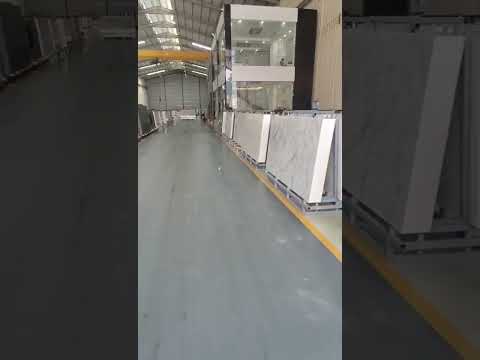
Visiting halls and finding stone suppliers in China
If you process stone and want to start importing on your own, or you already import but want to improve your setup, contact us and we’ll gladly help you build a safe and profitable sourcing system from China.