

The EU is gradually closing the loopholes that allowed small parcels from China to enter with almost no customs duties. This means that small, one‑off orders will become less profitable, while serious bulk importing will once again come to the forefront.
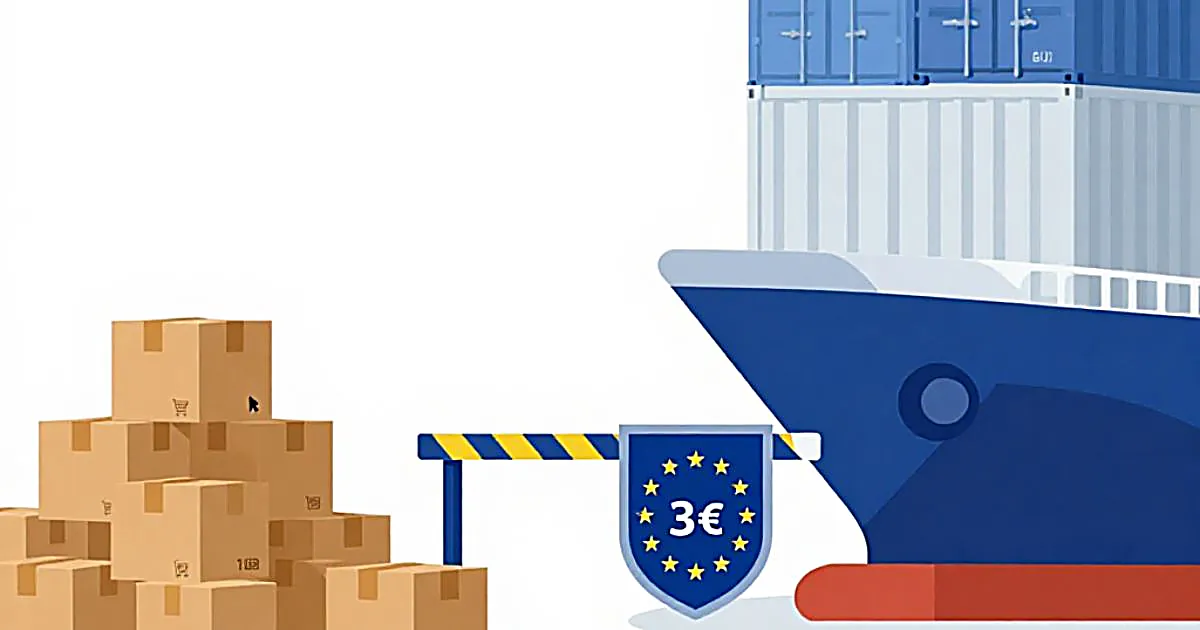
New rules have already been adopted to curb unfair competition from cheap e‑commerce shipments and to bring small parcels from China under the same regime as standard imports. In practice, this means a flat customs duty of €3 on small consignments, followed by the removal of the €150 threshold for charging customs duties.
For end consumers this is a price increase, but for bulk importers it is a clear signal that trading conditions will level out and that the time has come for more serious planning of B2B imports from China.
Why the EU is changing the rules for small parcels from China
For years the European Union applied a rule under which parcels worth up to €150 were exempt from customs duties and only VAT was charged. This opened the door to an explosion of cheap e‑commerce parcels, primarily from Chinese platforms.
In 2024 an enormous number of parcels worth under €150 were imported, with a large share coming from China. Many shipments were deliberately undervalued to stay below the €150 threshold, and goods were often split into multiple small parcels to avoid customs duties.
The result has been unfair competition for European retailers and bulk importers, weaker control over product quality and safety, and a huge amount of packaging waste. That is why the EU has decided to modernise the customs system and close this loophole.
Phase one: flat €3 customs duty on small parcels
As a transitional solution, EU member states have agreed to introduce a simple model for low‑value consignments under €150: a flat customs duty of €3 per e‑commerce shipment.
The new rules are planned to take effect from 1 July 2026 and will apply mainly to low‑value e‑commerce parcels entering the EU, most often from China. Until now these parcels passed through without customs duties, with only VAT being charged; in future they will also carry an additional customs cost.
An important detail is that this €3 charge is not applied “per parcel” but per category of goods within a parcel, according to the customs tariff number (HS code). If a single parcel contains, for example, one silk blouse and two wool blouses, these are two different categories – two customs lines are calculated, a total of €6 in customs duties (€3 for the silk blouses + €3 for the wool blouses).
€3 may sound negligible, but for goods worth €5–10 it is a huge percentage relative to the product price. Mass ordering of low‑value items from China in separate small parcels will become much less profitable, because each category of goods in a parcel carries its own fixed customs cost.
In practice, the more different types of goods you have in one parcel, the higher the total customs charge on that parcel will be – even if the value of the shipment is still below €150.
More details on this package of measures are available on the official website of the Council of the EU: Modernising the EU customs union .
What this means for end consumers
For consumers in the EU, especially those who order small items from AliExpress, Temu and similar platforms, this is a clear price increase. Every parcel will incur an additional customs fee, which is particularly noticeable for cheap products.
At the same time, the EU is sending the message that a small parcel is no longer a “gift” or negligible risk, but a serious part of imports that must comply with basic customs and tax rules.
Phase two: removal of the €150 threshold and customs from the first euro
The flat €3 customs duty is only a transitional step. In parallel, a much larger change is being prepared: a complete reform of the EU customs union through the introduction of the EU Customs Data Hub – a central digital system that will collect data on goods and consignments for the entire EU.
Once this system is fully operational, the €150 threshold for customs duties is expected to be abolished. This means that customs duties will be charged:
- on consignments worth €20,
- on parcels worth €80,
- on shipments worth €140 – in short, on all values from €1 upwards.
Instead of the current system where low‑value e‑commerce has effectively enjoyed a privileged treatment, small parcels will move into the same customs regime as standard container imports: application of HS codes, real product values and customs rates.
What this means for bulk importers
For end consumers these changes are bad news – small parcels from China will be more expensive and more complicated. However, for bulk importers and distributors the situation is different.
Until now the model of “shipping goods directly to end customers in the EU in thousands of small parcels” had a major advantage: goods often slipped through without customs duties or with minimal costs. Standard container imports with customs and VAT looked more expensive and slower.
With the introduction of the flat duty, followed by the complete removal of the €150 threshold, that gap is narrowing. Small parcels will no longer enjoy a customs “discount”, while the usual model of serious imports – groupage freight, containers, warehousing in the EU and distribution – gains a relative advantage.
Bulk importing becomes the more logical choice for companies that:
- want stable margins and clear unit costs,
- do not want their business to depend on loopholes in the customs system,
- plan to build brands and distribution over the long term.
How companies importing from China should prepare
If you are already importing or are considering importing goods from China for the EU market, the new customs measures need to be built into your planning well before they are fully implemented. In practice, there are three key steps.
1. Re‑evaluate reliance on small parcels
A business model built on a series of small shipments “up to €150” will become less and less viable with the introduction of the flat €3 duty, and after customs starts being charged from the first euro it will practically stop being competitive for any significant volume.
Small parcels will still make sense for:
- samples and market testing,
- one‑off, specific low‑value orders.
But as the main basis of a serious import business, this model is entering a high‑risk zone – both in terms of costs and regulatory changes.
2. Shift focus to more serious B2B importing
Instead of relying on small e‑commerce platforms, more and more companies will have to think in terms of:
- direct cooperation with Chinese manufacturers,
- groupage or full‑container shipments,
- importing into EU warehouses and local distribution.
This requires a different approach – negotiating factory prices, checking quality before shipment, supervising loading, and optimising routes and transport. But unlike small parcels, this model does not depend on whether some loophole in the regulations will be closed tomorrow.
That is exactly what we do at uvozizkine.com: selecting suppliers, factory inspections and organising transport for companies that want stable B2B imports from China instead of relying on “luck” with small parcels.
3. Prepare costings for the new customs regime
Since the new EU rules have already been adopted and the date of their introduction is known, it is increasingly important to build into your costings:
- the flat €3 customs duty per small parcel (from 1 July 2026),
- the customs rates that will apply to your goods once the €150 threshold is removed and duties start being charged from the first euro.
In practice this means it is time to check:
- which HS codes (tariff numbers) apply to your products,
- what customs rates apply to those codes,
- how all of this fits into your pricing plan for the EU market.
If you are dealing, for example, with imports of machinery, tools, chemicals, household equipment or agricultural machinery, these calculations are an essential part of business planning.
How Gabriel Group can help you adapt
Gabriel Group has been helping companies for many years to source goods from China safely and cost‑effectively and to organise the entire import process. The new EU customs rules only accelerate a trend that is already visible: less room for improvisation and “creative” importing, and more need for planning and a professional approach.
If you are wondering how these changes will affect your specific product range – whether it is machinery, consumer goods, industrial materials or finished products – we can help you:
- analyse your current sourcing model in China,
- assess the impact of the new customs rules on small parcels,
- develop a realistic plan for moving to stable B2B imports with full customs and logistics control.
This information is intended to help you make decisions about importing from China based on facts rather than assumptions. The EU customs system is changing – the only question is whether you will react to those changes in time.
Planning imports from China for the EU market after 2026? We help you find suppliers, control product quality and organise transport, with a team on the ground in China.
Send an inquiry →Frequently asked questions
Will every order from China be charged the €3 duty?
The flat €3 duty applies to low‑value e‑commerce consignments up to €150 entering the EU and is charged per category of goods in a parcel. Standard B2B imports use regular customs calculations based on tariff rates.
Does it still make sense to order low-value items from China?
After the flat duty is introduced and the €150 threshold is removed, small orders mainly make sense for samples and one‑off purchases, while for any larger volume B2B importing becomes more profitable.
From exactly when will the new EU rules apply?
The flat €3 customs duty is planned from 1 July 2026, and the removal of the €150 threshold will follow in the next phase, once the EU Customs Data Hub system is fully implemented.
Prepared by Gabriel Group, a team specialising in finding suppliers, quality control and shipping goods from China to markets around the world.