

1. What exactly we did
When we started working as a sourcing agent for China and launched the first version of our website (around 2008–2010), Alibaba was the obvious starting point. We collected companies that were listed on Alibaba at that time, but we only included those that also had their own website – which back then was one of the signs that a company was serious.
In total, we collected 11,720 Chinese companies and grouped them into 30+ categories based on Alibaba’s structure at the time (machinery, electronics, clothing, footwear, chemicals, energy, and more). These companies are still visible in the Chinese Companies section of our site, as a historical snapshot of what once stood behind Alibaba’s catalog.
You can see all of these companies today in a dedicated part of the site, Chinese Companies, where they’re organized by industry category. Next to each company name you’ll also see the year when we first published the link, which gives you an extra sense of how long a supplier has been around.
For years, Google kept warning us about issues with those links. We knew a lot of them were broken, but nobody really wanted to take on the job of checking more than 11,000 links – until we finally decided to go through every single site systematically in 2023.
If you’re thinking about buying from Alibaba on your own and wondering how stable a supplier really is, the following data will show you how long Alibaba companies actually “last”.
2. What we discovered when we checked the companies
During this big link audit, we kept running into three main situations:
- The link leads to a website of a company that is still active – the domain exists, the site is live.
- The link leads nowhere – expired domains, 404 pages, or completely shut‑down sites.
- The link has been taken over by third parties – today it leads to betting sites, shady services, or adult content.
As we went through thousands of domains, it became clear that the problem wasn’t just “a broken link”, but the fact that a large number of companies that once looked serious simply no longer exist. In other words, if we had relied only on the old Alibaba profile and the company website at that time, many of those suppliers would now be completely out of reach.
3. Statistics that should worry you
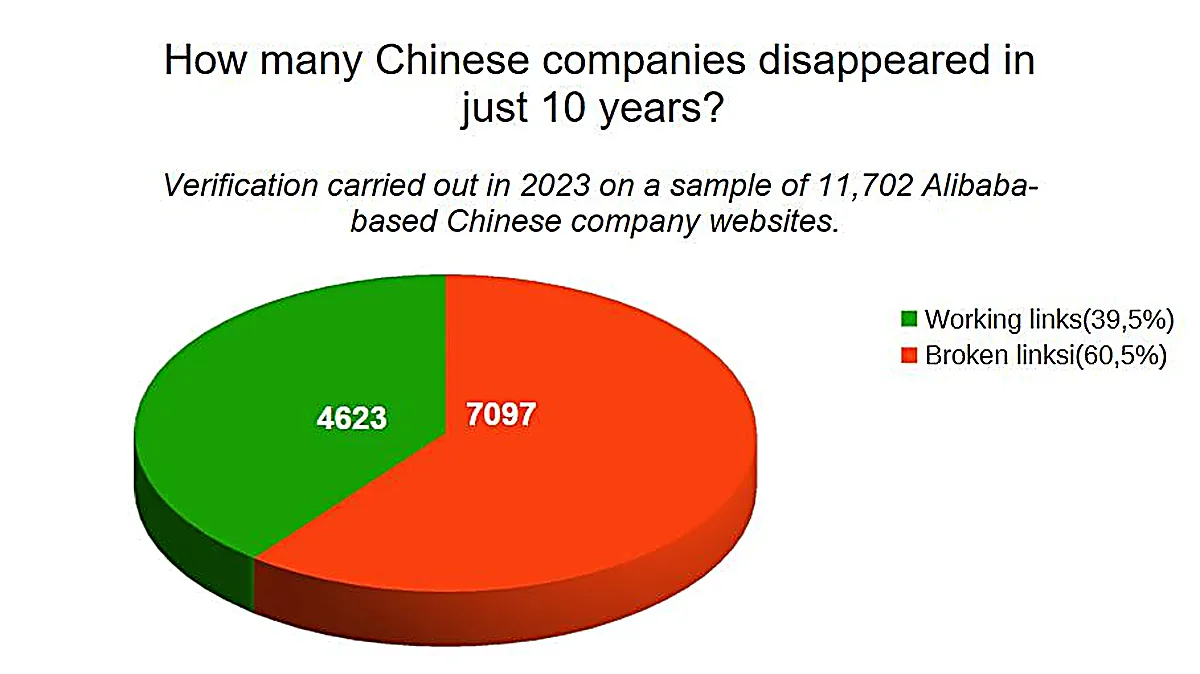
Once we finished the checks, we came to a conclusion that even surprised us: out of 11,720 Chinese companies that we listed between 2010 and 2014, by 2023, 60.5% of them had disappeared. That means that more than 7,000 websites were shut down, taken over, or now lead to dead pages.
The most stable turned out to be companies from heavy industries – at the top are chemicals (56% of companies still active) and energy (55.71%). On the other hand, consumer‑focused industries look much worse: in the clothing category, only 21.67% of companies are still operating today, and in footwear only 25.28% of the original suppliers are still around.
The detailed table with all categories and exact percentages is below – you can see the share of companies that still exist for each of the 34 categories.
4. Detailed table by category
| Category | Total companies | Companies still active | % still active |
| Chinese cars | 180 | 66 | 36.67 |
| Mechanical parts | 400 | 202 | 50.50 |
| Machinery from China | 400 | 201 | 50.25 |
| Transport | 400 | 140 | 35.00 |
| Agriculture | 400 | 167 | 41.75 |
| Furniture | 360 | 110 | 30.56 |
| Textile and leather | 400 | 130 | 32.50 |
| Food and beverages | 400 | 195 | 48.75 |
| Sports and entertainment | 400 | 185 | 46.25 |
| Construction | 400 | 143 | 35.75 |
| Minerals and metallurgy | 160 | 68 | 42.50 |
| Industrial equipment | 200 | 106 | 53.00 |
| Chemicals | 200 | 112 | 56.00 |
| Energy | 140 | 78 | 55.71 |
| Clothing | 360 | 78 | 21.67 |
| Bags | 400 | 146 | 36.50 |
| Beauty and personal care | 400 | 180 | 45.00 |
| Toys and hobbies | 400 | 180 | 45.00 |
| Consumer electronics | 400 | 120 | 30.00 |
| Electrical equipment | 400 | 169 | 42.25 |
| Electronic components | 200 | 84 | 42.00 |
| Computers | 400 | 145 | 36.25 |
| Home appliances | 360 | 149 | 41.39 |
| Power tools | 400 | - | - |
| Footwear | 360 | 91 | 25.28 |
| Gifts and crafts | 400 | 165 | 41.25 |
| Telecommunications | 400 | 118 | 29.50 |
| Tools | 400 | 183 | 45.75 |
| Lighting | 400 | 130 | 32.50 |
| Office supplies | 400 | 127 | 31.75 |
| Home and garden | 400 | 142 | 35.50 |
| Fashion accessories | 400 | 128 | 32.00 |
| Health and medical | 400 | 191 | 47.75 |
| Packaging and printing | 400 | 194 | 48.50 |
| TOTAL | 11720 | 4623 | 39.45 |
From the table you can see that the categories with the highest share of companies still operating after 10+ years are Chemicals with 56% and Energy with 55.71%. The biggest drop is in Clothing, where only 21.67% of companies are still active, and Footwear with 25.28% of the originally listed suppliers.
If you want to move from these numbers to actual companies, visit the page Chinese Companies, where all of this data is linked to real supplier websites, grouped by category.
5. What this statistic means for you as a buyer
These numbers aren’t “statistics for the sake of statistics”. They show how uncertain it is that the company you’re working with today will still exist in five or ten years – even if it once had a serious Alibaba profile and its own website. This is especially true in consumer industries (clothing, footwear, fashion accessories, consumer electronics), where companies appear and disappear very quickly.
It’s also important to keep this in mind: you are very likely not the best, biggest, or most important customer that supplier has. If the company runs into trouble or doesn’t have enough orders, it often simply disappears – regardless of the fact that you have a signed contract, regular orders, and plans for future cooperation.
When a supplier suddenly disappears or stops delivering goods, it triggers a whole chain of problems: delays, empty warehouses, cancelled deliveries to your customers, refunds, lost deals. In short, the statistics we collected show that this doesn’t happen rarely – it’s actually the fate of more than half of the Alibaba companies in our sample.
In short, this means:
- More than 60% of companies in the sample disappeared within 10+ years – even though many once looked serious.
- Heavy industries are more stable – chemicals, energy, and industrial equipment have the highest share of companies still operating.
- Consumer industries are the riskiest – clothing, footwear, and similar categories have the highest percentage of companies that disappeared.
- A contract is not a guarantee the company will survive – if your supplier disappears, your plans and obligations to your customers remain.
6. How to reduce your risk
The statistics alone won’t solve your problems, but they help you ask the right questions. If you want to build a long‑term relationship with a supplier in China, you need to seriously research the company you’re working with – not just look at their Alibaba profile and current product listings.
Our suggestion is to stop thinking of buying on Alibaba as “click and order”, and start treating it as a project that requires checks, inspections, and planning. These articles can help:
- Tips for safe shopping on Alibaba – how to check the supplier, reviews, certificates, and red flags before you pay.
- How to buy from Alibaba – a step‑by‑step guide from the first message to payment and delivery.
- How to Find and Verify Reliable Chinese Suppliers – a detailed guide on how to verify companies from China.
If you don’t want to go through all these steps on your own, we can take over the whole process for you: supplier checks, product inspections, negotiations, logistics, and shipment tracking.
Want safer buying from China?
If you want to reduce the risk of a bad supplier, a company suddenly disappearing, or problematic products, send us a message and tell us what you want to import. We analyze the product, suggest options, and help you make a decision based on facts, not luck.
More articles on Alibaba and AliExpress
If you want to move from an overview of the Alibaba ecosystem to concrete steps, experiences, and safe buying, check out these articles:
Overview
-
Alibaba Group
Overview of the Alibaba ecosystem: Alibaba.com (B2B), AliExpress, 1688, Taobao, Tmall, and key differences. -
Alibaba – pros and cons
Advantages, risks, and when Alibaba is the best solution for your business.
Buying and safety
-
How to buy from Alibaba
Step‑by‑step: registration, search, communication, samples, negotiation, ordering, and payment. -
Tips for safe buying on Alibaba
How to protect yourself: Trade Assurance, supplier verification, red flags, and pre‑shipment inspection. -
Red flags when buying on Alibaba
The most common pitfalls, companies disappearing from the platform, and how not to lose your goods and money. -
Creating a Request for Quotation (RFQ)
How to write a good RFQ, filter quotes, and compare multiple suppliers at once. -
Alibaba experiences
Our Alibaba experience as buyers and why we don't use it. -
Selling on Alibaba – an inside look
If you want to see how Alibaba looks from the seller's side, read about our experience on Alibaba.
AliExpress
-
AliExpress – basics
How AliExpress works, when to use it instead of Alibaba, and how to test products in small quantities. -
AliExpress buyer protection
Buyer Protection, opening a dispute, refunds, and tips for safe buying.
Frequently asked questions about buying on Alibaba
Is it safe to buy on Alibaba on your own?
For small and simple orders, it can be safe enough, but for more serious importing the risk is much higher. Our long‑term sample shows that more than 60% of companies disappeared over a period of 10+ years, so detailed checks of the supplier and cooperation terms are essential before placing larger orders.
Which industries are safest for long‑term cooperation?
The most stable companies are in heavy industries – chemicals, energy, and industrial equipment. These categories have the highest share of companies still operating after 10+ years, which makes them more suitable for long‑term supplier relationships.
Which industries carry the biggest risk of suppliers disappearing?
The highest risk is in consumer industries – clothing, footwear, fashion accessories, and some segments of consumer electronics. In these categories, companies much more often disappear, change business models, or stop shipping products within just a few years.
Does a contract with a Chinese supplier fully protect me?
A contract is an important part of your protection, but it doesn’t guarantee the company will survive. If a supplier runs into financial trouble or disappears from the market, you still have obligations to your own customers, and contractual protection often can’t make up for lost time, goods, and reputation.
What’s the minimum due diligence I should do before my first larger order on Alibaba?
At a minimum, you should check the company’s registration and reputation, compare several suppliers, request samples, clearly define product specifications and delivery terms, and arrange at least a basic pre‑shipment inspection. For larger and ongoing imports, we recommend working with a sourcing agent in China who can perform in‑depth checks and on‑site quality control.
Supplier Guide
Finding and verifying suppliers
How to systematically find suppliers and check whether they’re truly reliable before you start working together.
How to choose a manufacturer in China
Practical criteria for choosing a factory once you’ve narrowed down your supplier list.
The Most Cost-Effective Way to Buy from China
Compare three buying options - cheap(B2C), cheaper(bulk on Alibaba), and most cost-effective(local factories + China agent).
How to Negotiate with Chinese Suppliers
A practical guide to negotiating with Chinese suppliers, with a focus on preparation, cooperation terms, and getting the right price.
MOQ and hidden import costs
What MOQ means, how to negotiate it, and which additional costs you should plan for before ordering.
Choosing Products to Import from China
Go back to our guides on finding profitable products and learn which regions of China specialize in different product categories.
← Back to Product SelectionCustoms and Import Regulations
Once you've selected a supplier, the next step is understanding HS codes, customs duties, product origin requirements, and the paperwork needed for importing.
Continue to Customs →Back to: ← China Supplier Guides
Back to: ← China Sourcing Hub